Young people across the US dismantling barriers for English learners
On a rainy Friday afternoon, Justin Nguyen reviews English grammar on his computer before a tutoring session with a middle school student in Birmingham, Alabama. His approach to teaching is rooted in his own experience of learning English after arriving in the US from Vietnam with his family as a child.
“I remember when I was really young, I always felt like the pariah in the classroom, not being able to fit in,” says Justin. Justin is one of thousands of young people across the US leading grassroots initiatives that support English language learners. From fellowships to local nonprofits, they are helping learners practise English beyond the classroom while building confidence and connections in their communities.
Justin helps reinforce English-language learning for underserved students with limited opportunities outside the classroom. He is contributing to the thousands of youth-led grassroots initiatives supporting English language learners across the US, contextualising English language development within the real world; from fellowships to local non-profits, young people like Justin are stepping up.
“Justin helps reinforce English-language learning for underserved students with limited opportunities”

Around five million students were learning English across the US in 2021. Summer also interrupts many publicly funded learning programmes and some students lose reading fluency before school resumes.
Justin serves as a volunteer with Birmingham Jumpstart, a nonprofit that supports students who have been left behind by traditional education systems. Knowing that trust cannot be built overnight, he works to understand what challenges they might face, creating personalised lessons which reduce classroom anxiety and create a safer space to learn.
Justin explains the progress he’s made with one student. “Throughout the school system she was shy, she felt embarrassed, and so that really could have hurt her progress in the future,” he reflects. “And it’s very exciting for me to see how excited she is every single time she comes. She’s always like ‘I’m really glad that I have you helping me out’.”
Dr Josephine Prado, ESL Program Coordinator at the University of Alabama at Birmingham, provides additional context on the psychological mechanics behind these efforts.
“When our brains are anxious, we’re going to go into a state of fight or flight,” says Dr Prado. “And that’s not when we’re going to be doing our learning, right? We’re in our defensive protective mode. You have to lower that anxiety for someone to settle.”
“ When our brains are anxious, we’re going to go into fight or flight – and that’s not when we’re going to be learning”

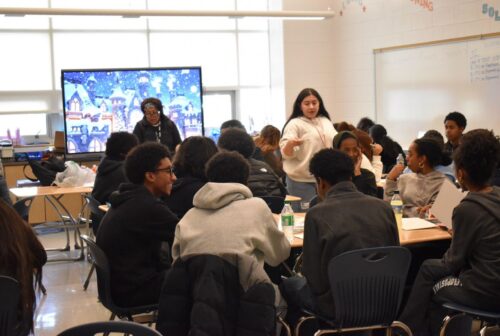
Hundreds of miles away, Hazel Bonilla is a young Programme Coordinator at the nonprofit Liberty’s Promise in Maryland. She supports high-school students in a similar way as Justin, delivering English language development programmes and training sessions. Working in multilingual classrooms where French Creole, Spanish and Portuguese are spoken, Hazel recognises that young immigrant students find themselves in vulnerable positions, unable to freely communicate when immersed in predominantly English-speaking communities.
Through her training – Civic Engagement for Beginning English Language Learners – Hazel helps students overcome communication fears by encouraging them to seek out opportunities in the US as they continue their linguistic journey. Civic literacy programming, teaching students about their civic rights and group college tours to support future planning are key to her role.
“With the students who are learning English, we try to give them as much information as we can in a language that they’re most comfortable in,” says Hazel. “It’s very hard for them to ask questions [about the training] because they tend to see that people don’t speak the languages they do. I use myself as a buffer.”

Justin and Hazel’s roles highlight that teaching English is much more powerful when it’s combined with peer mentorship. By contextualising language development within the real world, students learn more about themselves and how they can use their skills in the future. Young leaders can build this impact by stepping up for their community’s needs; whether it is championing language development or hosting college preparation classes, this next generation of leaders has the potential to make permanent change. For Justin, this means supporting current University of Alabama at Birmingham students to become potential English tutors like him. For Hazel, it means continuing to see her English language learners get into college and university.
Once the school year resumes, these young leaders’ commitment to their communities will be evident, as students whose language gaps may have silenced them previously now stand a bit taller. Even when institutions pause, young leaders like Hazel and Justin work to be a continuous presence to support these students and make a safer space for them to learn.
“ Students whose language gaps may have silenced them previously now stand a bit taller”