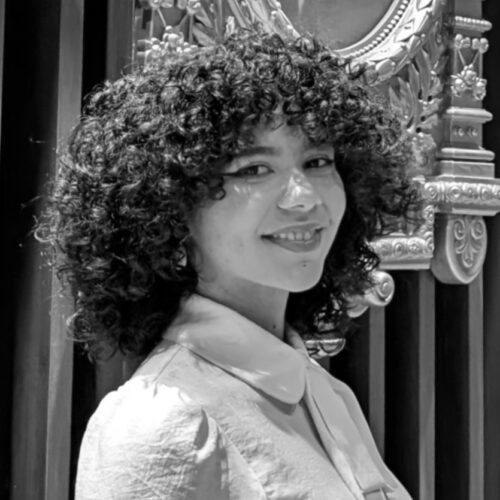
Eunice Vasquez
Eunice grew up in a rural community where education was limited and had to actively seek her own resources to learn. Now, she uses storytelling to advocate for the next generation’s access to education, especially for migrant girls who arrive in Honduras as their families migrate north. Through artistic methods including slam poetry and short stories, she shares how education has empowered these girls. Eunice aims to refine her journalism skills to amplify these narratives, de-stigmatise perceptions of migrants, and push for government protection of migrant children’s education.
“Writing this article is an act of love, memory and justice. Pie del Cerro, a small village in the mountains of Honduras, is where my mother grew up. It’s where she learned to read and dream under the branches of guava and nance trees, in a tiny multi-grade classroom with a teacher named José María Pinto, whom the children called “el profe Chemita”. It was there, in that classroom made of wood and possibility, that my grandfather Rafael encouraged my mother to keep going. That school, forgotten by many, was the birthplace of her curiosity, resilience and strength. That little girl who once had to cross muddy paths to get to class is now a businesswoman and the mother who raised me with a deep love for nature, knowledge and justice. Her story is the root of mine.
This issue is deeply personal but also profoundly political. Rural communities across Honduras have been systematically neglected. Quality education is not a reality; it’s a privilege denied. Children are growing up in a world where the state has forgotten them, where teachers are underpaid or not even on official payrolls, and where school infrastructure barely holds up under the rain. Yet, even amid this abandonment, I’ve seen creativity, collective care and resistance. Educators and families are doing the impossible every day with nearly nothing.
Through this article, I want people in positions of power to listen to these voices. Not with pity, but with commitment. I want them to understand that rural children deserve more than survival. They deserve opportunity, dignity and hope. They need policies, not just promises. Fixed contracts for teachers. Classrooms that don’t leak. Books. Connectivity. Support systems. If we gave them even a fraction of the resources we give to others, they would transform the future, not just for their villages, but for all of us.”